

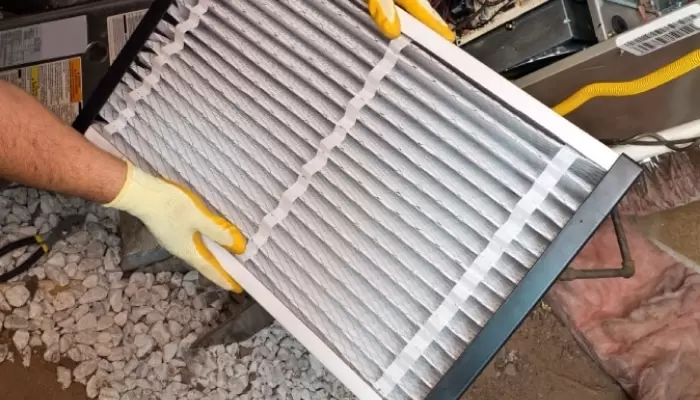
What Does MERV Actually Mean?
MERV = Minimum Efficiency Reporting Value
It’s a standardized rating (developed by ASHRAE — the American Society of Heating, Refrigerating and Air-Conditioning Engineers) that measures how effectively an air filter captures particles of different sizes.
Filters are tested against particle size ranges:
-
E1: 0.3–1.0 microns (smoke, bacteria, fine combustion particles)
-
E2: 1.0–3.0 microns (mold spores, dust mite debris)
-
E3: 3.0–10 microns (pollen, dust, pet dander)
Higher MERV ratings capture a higher percentage of smaller particles.
But here’s the nuance most HVAC companies fail to education homeowners about:
A filter’s efficiency rating does not automatically mean it is appropriate for your HVAC system.
Efficiency and airflow resistance are directly related.
Why MERV Ratings Matter More in North Chicago Homes
Indoor air quality is influenced by:
-
Heavy traffic corridors (PM2.5 infiltration)
-
Lake Michigan humidity swings
-
Long heating seasons (sealed indoor air)
-
Spring pollen spikes
-
Winter combustion appliance use
Because we keep homes closed for much of the year, airborne particles accumulate more than in milder climates.
That makes filtration more important but also more system-sensitive.
Questions Homeowners Usually Ask
Will a higher MERV lower my energy bills?
Not directly. Higher MERV improves air quality, not efficiency. If airflow drops, energy use can actually increase.
How often should I change a MERV 13 filter?
In Chicago’s seasonal climate:
-
Every 2–3 months typically
-
Monthly during high pollen or heavy AC usage
Higher MERV filters load faster because they capture more particles.
Does MERV 13 reduce viruses?
It can reduce airborne viral particles attached to droplets (which are typically >0.3 microns), but filtration is just one part of infection control. Ventilation (air changes per hour) matters equally.
What the Data Says About Filtration Performance
According to ASHRAE Standard 52.2 testing:
-
MERV 8 captures ~20% of E1 particles
-
MERV 11 captures ~65% of E2 particles
-
MERV 13 captures up to 85% of E1 particles
During wildfire smoke events and high PM2.5 days, studies show that upgrading from MERV 8 to MERV 13 can reduce indoor particulate levels by 50% or more.
If the system can handle it. That “if” is critical.
The Hidden Tradeoff: Static Pressure
Here’s what rarely gets explained clearly:
Higher MERV filters are denser. Denser filters increase static pressure.
Increased static pressure can:
-
Reduce airflow (CFM)
-
Overwork the blower motor
-
Increase energy use
-
Cause evaporator coil icing
-
Shorten system lifespan
Older Chicago homes with the following may struggle with MERV 13 unless airflow is tested and verified.
-
Narrow return ducts
-
Single central returns
-
1-inch filter slots
-
PSC blower motors (common pre-2015)
This is where many homeowners unintentionally create HVAC problems trying to “upgrade” air quality.
So What MERV Rating Is Best?
Here’s the practical breakdown for North Chicago homes:
MERV 8
Best for:
-
Older systems
-
No allergy sensitivity
-
Homes with good natural ventilation
Captures: Dust, pollen, lint
Limitation: Minimal fine particle protection (PM2.5)
MERV 11
Best for:
-
Most standard residential HVAC systems
-
Mild allergy concerns
-
Balanced airflow and filtration
Captures: Mold spores, pet dander, fine dust
Often the safest upgrade choice
For many North Chicago homes, this is the sweet spot.
MERV 13
Best for:
-
Homes with asthma or respiratory sensitivity
-
High pollution exposure areas
-
Newer ECM blower systems
-
Systems professionally airflow-tested
Captures: Smoke, bacteria, finer particulates
Requires airflow verification
This is the rating ASHRAE recommends in many public health scenarios but not every residential system is built for it.
When HEPA Makes Sense and When It Doesn’t
True HEPA filters capture 99.97% of particles ≥0.3 microns.
However:
-
Most standard residential systems cannot push air through a true HEPA panel.
-
HEPA typically requires a bypass system or dedicated filtration unit.
In North Chicago homes with significant health concerns, a professionally installed HEPA bypass system may be appropriate but it’s not a simple filter swap.
Why Ventilation + Filtration Work Together
Many homes rely solely on recirculated air.
But effective indoor air quality strategy involves:
-
Filtration (MERV rating)
-
Ventilation (fresh air exchange)
-
Humidity control (30–50% ideal range)
-
Duct design integrity
Upgrading a filter without evaluating airflow and ventilation is incomplete.
Recommendations for North Chicago Homes
If you want a safe, balanced, evidence-based approach:
-
Start at MERV 11
-
Monitor airflow and system performance
-
Upgrade to MERV 13 only if:
-
Your system supports it
-
Static pressure is measured
-
Blower capacity is sufficient
-
This approach balances:
-
Particle removal efficiency
-
HVAC longevity
-
Energy use
-
Comfort
Indoor Air Quality (AIQ) Is a System, Not a Filter
Your HVAC system is a mechanical ecosystem.
MERV rating connects to:
-
Blower motor type (PSC vs ECM)
-
Duct sizing
-
Return air design
-
Indoor humidity
-
Outdoor pollutant load
-
Home airtightness
That’s why “just buy the highest number” isn’t expert advice.
The best MERV rating is the one that improves filtration without compromising airflow.
Not sure which MERV rating your system can handle?
Don’t guess and risk airflow problems. Schedule a professional airflow and static pressure check with Topline HVAC. We’ll test your system, explain your options clearly, and recommend the right filter for your home. Not just the highest number on the shelf.
👉 Call (866) 867-5463 today to get expert guidance for cleaner air in your North Chicago home or contact us online with any questions.
Serving Skokie, Evanston, Lake Villa, Morton Grove, and surrounding suburbs.